
A blog about television by TIME’s TV critic James Poniewozik.

Mad Men Watch: Family Entanglements

AMC

AMC

SPOILER ALERT: Before you read this post, dump your liquor down the sink and watch last night's Mad Men.

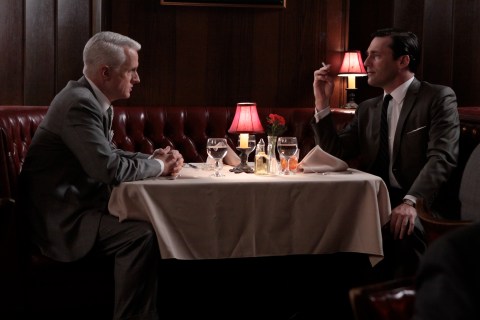
"I was in California. Everything's new, and it's clean. The people are full of hope. New York City is in decay. Madison Square Garden is the beginning of a new city on a hill."

Don Draper is never so insightful about himself as when he's talking about someone else. Don was in California--not just on business, but, as we learned last seas, it was a central scene of his reinvention. California in the '60s, like Don Draper, is a manifestation of the American dream, or one American dream: that Jay Gatsby desire that you can erase the past and start fresh. Where Paul Kinsey sees the past as a legacy to be preserved, this view sees it as a burden to be sloughed off.

How well does that work out? For Don, for California, for Gatsby? Or for Madison Square Garden? You have to know something about New York City history to know the irony of the pitch Don is making; the razing of the original Penn Station, which he eloquently makes the case for, is now widely regarded as one of the greatest civic mistakes the city has made. Architectural historian Vincent Scully said that, one used to enter the city, through Penn Station, "Like a god. Now one scuttles in like a rat." Arguably, it eventually contributed to the very urban decay that Don was talking about.

So, take Don Draper's sales pitch however you want.

And what is the enemy of detachment and reinvention? Roots. History. Family. "Love Among the Ruins" was, besides ruins, about the complications of family. And the further irony of Don's pitch to the Penn Station guys--other than the fact that the Brits ended up nixing the account after he landed it--was that this episode saw him taking on a further family entanglement. Indeed, the big one: taking in Betty's father, who's alone with encroaching dementia. This is domestic Don at work, the one who wants to be a good husband and a good father, to improve on his childhood not by escaping but by doing better.

So when Betty drops done the vague but unmistakable hint that she wants him to take care of things and frustrate her brother's designs on the family house, Don goes into full-on Sterling Cooper power mode, laying down terms and telling William to leave Dad's Lincoln and take the train home. Leaving the Drapers, with a new baby on the way, the caretakers of an elderly man pouring Don's expensive liquor down the sink because he thinks it's still Prohibition.

You can feel the roots curling around them. Not necessarily in a menacing way: Betty seem happier than we've seen her in a while, if sadly so, and Don appears to genuinely enjoy having Gene around on some level. But this new commitment leaves them as far from "California"--the unburdened state of mind Don described--as is possible.

This new Don wants to do right by Betty and her family out of love, but if love's not sufficient, he'll do it out of duty. Which is probably why he now makes no attempt to hide his contempt for Roger, who left his family to follow his bliss and marry Jane. There's no zealot like the reformed (and reforming) sinner, and the former Dick Whitman can't respect Roger for weaseling out of his own family complications.

Roger, for his part, can't understand why the world wouldn't want him to be happy, and can't understand why his daughter can't move past his divorce and welcome him (and her new sister-stepmom) at her wedding. That blessed occasion would seem doomed even without the date engraved on the invitations: Nov. 23, 1963, the day after the Kennedy assassination.

(The JFK assassination, by the way, is the main reason I was a little surprised that Mad Men didn't jump further in time this season, if only to avoid the event and jump straight to its aftermath. The shooting can be a cliche-trap for period dramas, like NBC's American Dreams, about which I wrote back then, "the pilot begins on a snowy day in November, setting up the hackneyed loss-of-innocence climax so obviously that you half expect a TV to crackle, 'And in other news, President Kennedy will be assassinated in three days.'" Mad Men, on the other hand, has been good about showing how people react to history in ways you wouldn't expect, or ways that the pop-culture narrative has forgotten, so I'm very interested to see how it handles The Big One. And will the wedding still go on? I'm betting yes, and that it will be very uncomfortable.)

The final major storyline belonged to Peggy, who is handling the complications of having avoided family complications. Having given up the baby she had at the end of season 1, she's a single professional in New York City, successful and on the rise at Sterling Coop, but not so much so that she's not hemmed in by embodying "the woman's perspective" in a men's office. In the opening scene, you can almost taste her amazement that none of the men in the room can see past Ann-Margaret's looks to her god-awful singing ("Bye! Bye! BIRD-hee!") or to what a lousy idea Pepsi has to sell its new Patio Diet Cola.

Unfortunately, nobody is interested in the simple notion that maybe you should sell women a diet cola by appealing to women, not to men. What I love about the way Mad Men portrays Peggy, and the way Elisabeth Moss plays her, is that we can see her both repelled by and attracted to the Bye Bye Birdie fantasy—she fights the sales pitch and sings the song to herself in the mirror—and it doesn't expect us to accept that only one of these represents the "real" Peggy. She's as complicated and contradictory as Don, and when her appeal to him doesn't go her way, she unwinds the way Don Draper might: by going out and getting a little something for herself.

Remembering, this time, the importance of protection. Because we all know where family entanglements can lead.

Now for the hail of bullets:

* Again with Joan and the subways? Her joke (repeated later by Peggy, as if to assume Joan's persona) about a crowd of men reminding her of the subway recalls her statement last week that she never takes the subway. Is this about something more than that big rock on her finger?

* The way the London office shot down the Madison Square Garden account—on the grounds that it would cost too much in manpower in the short term—is in its way more menacing than if London had had some grand, nefarious scheme. Don realizes that Sterling Cooper's new owners either can't see, or aren't interested in, the value of investing for long-term growth. Either they're dense, they're in big financial trouble, or they're simply committed to managing Sterling Coop for the bottom line, sucking the lifeblood out of it through payroll savings. The British overlords are in managed-decline mode, not in empire-building mode; their thinking is as un-California-like as is possible. One way or the other, Don must realize, the company is in the clutches of a dying empire.

* What parent did not see a flash of recognition in this Don Draper line? "We are going to Tarrytown, and you're going to stare at some antique chair so long the buttons are going to seem interesting. Then we'll go get Carvel." And you will like it!

* I love the last couple of scenes first with Don brushing his hand through the grass while watching the maypole dance, then Peggy meeting with him to discuss the Pampers account after her one-night stand. Each, in their own way, has been seeking a taste of freedom, which only underscores my image of Peggy as a kind of female Don—not exactly the same in morals or circumstance, but with some of the same conflicts and paradoxes.

* I like how the show has portrayed William, Betty's brother. At 30, he comes across a little immature and petulant, but at the same time you get the sense that, back in his history, he probably does have legitimate issues with his sister. In little scenes and quick strokes, you get this deft portrait of how a short lifetime of resentment and being under his father's thumb has curdled in him.

* Fun fact: Ada Louise Huxtable—the powerhouse New York Times architecture critic that the MSG guys disparaged as "an angry woman"—is still doing criticism, for the Wall Street Journal.

  • Print
  • Comment
Comments (17)
Post a Comment »
  • 1

    "The way the London office shot down the Madison Square Garden account—on the grounds that it would cost too much in manpower in the short term—is in its way more menacing than if London had had some grand, nefarious scheme. Don realizes that Sterling Cooper's new owners either can't see, or aren't interested in, the value of investing for long-term growth. Either they're dense, they're in big financial trouble, or they're simply committed to managing Sterling Coop for the bottom line, sucking the lifeblood out of it through payroll savings. The British overlords are in managed-decline mode, not in empire-building mode; their thinking is as un-California-like as is possible. One way or the other, Don must realize, the company is in the clutches of a dying empire."

    Sound like any journalism companies you know?

  • 2

    Spent much of the hour waiting for Peggy to have a "big moment," but then I remembered what show I was watching. Somehow I think "Mad Men, where the big moments are small" is a slogan that will never catch on.

    CC Follies: I think last week was an aberration. Last night's captioning was back to season 2 quality (about a B+). We find that the captioner cannot penetrate Embeth Davidtz's accent. Thus we read that the Pryces live in a "finished" (furnished) apartment, and she welcomes "the cookie" (the coquille). And when Mona dissed Roger's child bride by calling her June, the caption "corrected" her to Jane. Nothing else as fun as those. My sympathies to the captioner, by the way, for whatever life circumstances cause him to know the correct spelling of Coumadin.

    One curiosity. When Gene wanted to watch the end of the ball game, the television was playing something inaudible which, per the caption, featured a character named Poko. The only Poko I can find is a kids' show from Canada which started in 2003. Anybody have an idea what show the kiddies were watching in 1963?

  • 3

    I got more the sense that Don was less playing the family man than he was to get his wife to stop nagging him, based on his body language and behavior in the bedroom scene. Bringing an old man who needs care into your home should be an important decision vs. winning a dispute. It means one of two things to me: 1) They're removing intuition and foresight out of Don's character to create new story lines 2) Don doesn't plan to be home much.

  • 4

    If Peggy is the female Don--with the same ambition and also having skeletons in her closet--then how to explain her startling line, "My boss is a jerk?" How could she say that about the man who taught her how to move on when she was at her most confused and vulnerable? Does Peggy now regret her act or is she miffed at Don over the Patio account or is she talking about Sterling because of what happened in the elevator? I thought Don and Peggy were the closest in the office so that line surprised me.

    Pepsi had a drink named Patio? One shudders.

  • 5

    Although it's been said many times before, I can't help but say again how wonderfully this show has captured the interesting (unhealthy?) family dynamic present in many WASP families. Gene's removal of the children from the television so he could "catch the game" (whether actually on or not), was such an accurate portrayal of the 60's grandfather (in this case, my great-grandfather), who's kind of mean and always expects to be given the right-of-way in the house. Additionally, the Carvel scene already mentioned in the post was amazing. And even something as simple as Don yelling at his children (who I assume were jumping on the bed), "Knock it off!" from the other room. Betty's assertion that Carla must have eaten the last of her snacks because she herself would have surely thrown away the box when it was empty. Just...sigh...splendid.

  • 6

    I also liked how we got another false/wrong compliment of Betty's cooking (from William's wife) when we've seen that Betty isn't really much of a cook, especially by 1960 standards.

  • 7

    Also great:

    1) The different styles of the dueling "Heads of Accounts". Especially the slimy way Pete Campbell deals with the MSG situation ("Do you hear yourself?")

    2) I took Peggy's "My boss is a jerk." comment to be in reference to Sterling, but perhaps I'm simply not reading enough into this...

    3) A little disappointed that the show has decided to bury the gay man during the 1960s internal struggle (as I see it to be a potentially complex and interesting one), although I suppose the manner in which the show has dealt with it (granted, only two episodes in) - meaning to bury it and not discuss it - is probably an accurate depiction of how it was handled in 1963. We've still got 6 years til Stonewall...one can only dream that Mad Men lasts so long.

  • 8

    Thanks James. I thought it might have been that.

    BTW, if a classical idea of a comedy is always end it with a wedding, then Roger and Jane's nuptial might end the season and because of the day, have more than enough tragedy. But if it is a season capper, how far apart will the remaining episodes have be in the timeline to get to that date? I could see a 22 episode season covering it, but if currently, it's spring of '63, we have a ways to go before that day. And I'm wondering: what can they really do with JFK that they didn't do before with Monroe's death? All the women would be crying and the men--specifically Don and Roger--would, over drinks, of course, talk about the ephemeral nature of life. Roger just might leave his wife for a pretty, young secretary! And these guys don't strike me as political and if they were, they would be Nixon boys. Maybe the producers could set it up by having Don over the course of the season become a JFK man. I'd be much more interested in how they handle MLK and his jail time and March on Washington.

  • 9

    I took Peggy's "jerk" comment to be both actual venting on her previous meeting with Don and part of the persona she adopted for the hook-up: she didn't correct the secretary bit, instead establishing "frustrated, overworked typist" as her identity for the night.

    And I found Don's "grass" bit to be overwhelmingly sexual. Though my opinion could have been swayed by the camera-work focusing on the teacher...

    • 9.1

      Ditton on the overwhelmingly sexual bit...especially in regards to Peggy's comment earlier in the episode about Ann Margaret's ability to "act 14 and look 25". Also - although it pained me that my mind jumped to such a crude/crass place - you could even harken back to the old "grass on the field...play ball!" saying...(I'm so ashamed)...at the end of the day, however, it all goes back to Don's search for a more innocent, happy (youthful?) time - before he confused his life with lies.

    • 9.2

      I do think that Peggy was truly mad at Don. He spouted the cliche and she could not correct him. That's what led her to the bar.

      But I think that her one night stand is Peggy's way of getting some "experience" - that will inform her career - in a very tactical way. Tactile, too , I guess. I think she feels like there are some things she doesn't get (how to sell to a man? take a big bite of that burger!), and she is doing her homework.

      And Don's caressing of the grass harkens back to his bedtime story to his wife last week (sand, beach chair). Wonder if this will be related to the Patio creative?

  • 10

    Last comment and self-correction: the wedding of Roger's daughter and not his own.

  • 11

    [...] James Poniewozik [...]

  • 12

    I also thought Peggy's line about hating her boss was part of the role she was assuming for the hook-up. It sounded like something she thought a secretary would say. Like the subway line.

  • 13

    I kind of thought Peggy was talking about herself when she said "my boss is a jerk." She was adopting the secretary persona--and she spent a lot of time complaining about her "girl." I think a lot of the encounter was Peggy wishing her life was easier than the life she's chosen. She has a wonderful career and she's successful, but sometimes she needs a break from challenging a male-dominated workplace (and, by extension, a male-dominated society). If you're vacationing from your identity, you can do worse than choosing one you envy--and she sees the secretaries as having it easy (hence her slightly-too-bitter complaining about her own secretary). And when she says "I have to go to work" when she's leaving the guy's apartment, she means she has to go back to being Peggy. She's ready to get back to work and sell Pampers.

Add Your Comment:

You must be logged in to post a comment.
Tuned In Daily E-mail

Get e-mail updates from TIME's Tuned In in your inbox and never miss a day.

Quotes of the Day »

Get & Share
ROBB LEVIN, resident of Fairfax, Virginia, on the $15,000 lawsuit settlement made against Tareq and Michaele Salahi, the White House gate crashers, who are also involved in at least 15 other civil suits

Stay Connected with TIME.com