
A blog about television by TIME’s TV critic James Poniewozik.

Mad Men Watch: Where Were You When?

madmen0312

AMC

SPOILER ALERT: Before you read this post, slow the playback to one-quarter speed and watch last night's Mad Men.

As a period drama set in the '60s, Mad Men had a choice to make: it could depict its characters against the big historical events of the day--which have been treated over and over in movies and TV--or it could skirt around them. Since the first season, Mad Men has committed, more than I would have guessed, to the head-on approach--ending the first two seasons around the 1960 election and the Cuban Missile Crisis--but focusing on how the events affect or reflect the personal lives of the characters, as opposed to "How we all lost our innocence," &c.

Last night, Mad Men faced the Big One, the Kennedy Assassination, which has loomed over this season since it jumped to the year 1963 and showed us the invites for Margaret's wedding--on Nov. 23, 1963. The episode brought the news in as if it were the Cloverfield monster, weaving in and out of scenes in which it came this close to pouncing on the characters: CBS News breaks in with a special bulletin just after Harry turns down the volume to talk to Pete, the scene cuts to Don arguing with Lane Pryce, Duck unplugs the TV after first news of the shooting.

And then, suddenly, it's everywhere: on every screen, in every head, every phone ringing at the Sterling Cooper offices. And, as happens in times like this, the TV stays on, through the workday, through the wedding, into the night and the weekend and through Jack Ruby's shooting of Lee Harvey Oswald. Which, as Betty's horrified reaction starkly showed, was maybe the moment when it seemed that more than a tragedy had happened: everything, everywhere, had just gone crazy, all the sublimated violence bottled up in America was now right out there on the surface and on live TV, and maybe it was just never going to stop, ever.

Then, as they say, everything changes--in the lives of a few of the characters, at least.

A personal digression, for just a minute. My first, knee-jerk reaction to Mad Men using the assassination this way (as the moment when Betty decides things are over with Don and when Pete and Trudy decide things are over with Sterling Cooper), was that life doesn't really work that way. History is history and life is life and connecting big events in one with big events in the other is artificial.

But then I thought about the closest thing I've experienced in my adult life, 9/11, which I was in New York for. And I had to admit that it does work that way, at least sometimes. I won't bore you with the details, but I made decisions afterward--nothing as momentous as here, but still--that were directly prompted by the fact that, one morning, 3,000 people were killed out of the blue because they took a ride on an airplane or showed up to work at their desks.

Now, would I have done anything differently if the hijackers were caught and 9/11 never happened? I don't know. I can't know. Certainly there were other personal factors in my own decisions: I'd just become a father, for instance. It may be that 9/11 changed me; it may be that it crystallized things that were in the back of my mind; or it may be that it simply gave me permission to do things that, in the back of my mind, I already wanted to do. And before long, other people I know told me they'd done the same.

Bottom line, though, it made people make personal changes--not everybody, of course--even though, had you written it into a script before, it would have seemed forced.

Digression over. Last week, there was that scene of marvelous ambiguity after Don's forced confession, when Betty saw him the next morning, handed him his sandwich and seemed stronger and more at peace than we'd seen her in a long time. Were things over, or was their marriage actually on the mend for Don's having come clean?

Well, three weeks passed and Don and Betty are still together. Then comes The Big One. And then Betty sees Henry at the wedding. Is it the assassination--or that world-gone-crazy Jack Ruby shooting--that forces Betty to decide that she doesn't love Don anymore? Is it that Henry asks her to marry him, and she sees a practical future after Don? Is it her loveless kiss with Don? Or is it simply something she already knew, but that the holiday of the national trauma--normalcy is suspended, the routine is broken--gives her permission to say out loud?

Last season, the Cuban Missile Crisis arguably saved the Drapers' marriage, pushing them closer together at the possible end of the world. Last night, it may just be, the country's next crisis ended their marriage: "There's no point. There's no point, Don."

"The Grown Ups" did a nice job of showing how various characters reacted to the news in their own way. Don's response coming home was spot-on: his first instinct is to shield the children from the news and get them away from the TV--though he relents and talks to them about the assassination instead, in terms that you might use to talk to kids about, oh, say a divorce. We'll be sad for a while, but we'll be OK. Peggy, meanwhile, sits bolt upright in bed at the news, shocked, but later--like Don and yet unlike him--goes into the office to immerse herself in her work.

Everything does not change for everyone; Margaret's wedding still goes on, though her meltdown early in the episode suggests she might have welcomed an excuse to call it off. (Before the assassination, she gives up when Roger calls her bluff on that.) The wedding is, on the one hand, awkward and uncomfortable--especially since, as Pete notes, the room is full of people who never liked JFK to begin with.

And yet there are no good answers here either way. In his eyes, forging on with the wedding is his grown-up responsibility to his daughter. It's horrible, as Roger later admits to Joan--he's not stupid, and he's not unaware of the inappropriateness. Roger has been contemptible in a lot of ways, leaving his wife and sousing his way through his work. But ironically, in this most uncomfortable moment, he's strangely sympathetic, even as he throws a party while the country is burying a President. He's slogging through an ugly situation that he knows is ugly, and, as Joan perceptively points out, he's doing it without his chief weapon: "My God, you're really upset." "What's that about?" "Because there's nothing funny about this."

Meanwhile, Peter has been taken down by the slow-motion train that Lane Pryce set on the track toward him in the first episode of the season. There's no deus ex machina or family connection to save him. He loses the Accounts job, and he loses it to Cosgrove in exactly the same way and for the same reason you would have predicted. Because Cosgrove is blessed. Pete can up his game, he can buckle down, he can have insights like the opportunity to market to African-Americans. None of it matters because Cosgrove can do the job better without even trying--just as when he published his short story in the Atlantic.

It's strange that Pete should become a figure of sympathy for this; after all, he was born on third base. The only reason he has his job is because of his old-money background and his old-school contacts. But he's run up against the one thing that he can't beat, which is Ken's effortless ability to have diamonds fall from the sky into his lap.

And this crushing blow comes after we've seen, over three seasons, that for all his unfair advantages, Pete actually does have talents and abilities. Most important, he has a vision that the rest of hidebound Sterling Cooper is unable to appreciate or even notice. He--this kicked-around scion of a blueblood family--somehow became the one person at Sterling Cooper with a sense of where America is heading. (Not always an idealistic sense, either, if you'll recall how eagerly he picked up on the chilling nukes-and-rockets aerospace presentation last season.) He's the one who saw Admiral TV's situation clearly, and got reprimanded for it. He's the one who saw that the future belonged to young people who didn't wear hats, like Elvis.

And--bringing it around to the terrible news--like JFK. After the assassination, he sees the situation in a way that sounds like he's talking about his own career: "It felt for a second like everything was going to change." But this is not just solipsism talking: it turns out Pete really is a Kennedy man. And while LBJ's taking over the Presidency may reflect his view of Sterling Cooper--the old guard is reaffirmed, the older generation is back in charge--it also cuts to something deeper and more idealistic. He realizes that he's just not like them. And more important, Trudy does: in another excellent performance by Alison Brie, who I just praised for her much-different work in Community, she comes around to the idea that Pete can't simply stay on at work as if nothing is different.

Again, who knows what's the chicken and the egg here? Does the assassination make Pete see that it's time for him to make a move? Is he even characterizing his coworkers fairly, or does his petulance over losing his job color the way he sees the assassination? (We never actually see or hear, you'll note, the horrible comments that he tells Trudy people made about the shooting, and the one specific he offers when asked--"He made a lot of enemies"--is kind of weak sauce.)

In the end, it's a philosophical question. In the end, for whatever reason, and whether it's a cliché or not, everything changes.

And now for the--I don't mean to be inappropriate, but this blog has traditions too--hail of bullets:

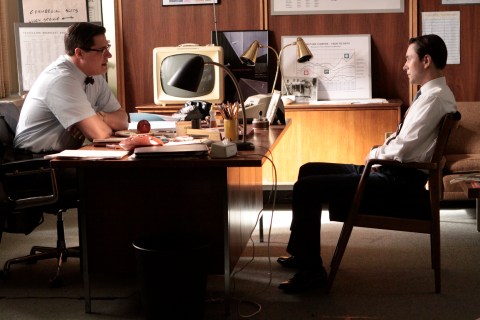
* The entire scene between Pete and Lane is well-played by both Vincent Kartheiser and Jared Harris (Pete contains his emotions but you can see his feelings in the way he sinks back on the couch), but the beauty moment came when Lane removed his glove to shake Pete's hand. Nice touch.

* So Peggy and Duck are a still thing! We had a big discussion when they hooked up over my (and others') "ewwww" reaction to Duck as Lothario; sorry, but--besides the ickiness of his coming on to her in the context of a job interview--I couldn't help remembering him as the weaselly, alcoholic sad sack we met him as. (Which, I don't know, may be why I react to him differently from fellow drinker and age-inappropriate dater Roger; Sterling can be contemptible, even loathsome, but he's not pathetic in the same way that Duck was.) But maybe Duck's changed; in any event, I hope we'll see more of what draws Peggy to the relationship (if it is a relationship beyond sex). I just want our Peggy to be happy.

* Walter Cronkite's announcement of JFK's death is probably the definitive anchor moment of the assassination, so it was good to see Mad Men not go only to that footage but also mix in NBC's coverage.

* I'm almost surprised that Pete isn't more resentful of Harry, who--as he himself pretty much acknowledges--had one good idea in his career and is living on the result. (Though he also notes that he's plateaued; he's going to die at his desk unnoticed, which may mitigate any jealousy of Pete's.) It's only fitting, then, that Harry, whose only job it seems is to watch TV--not that that's a bad thing!--is five feet from a television when he misses the most important program interruption of his lifetime.

* One last ambiguity to think about. Roger carries his drunk child bride into the bedroom and calls Joan. Maybe it's true that, at long last, Joan is The One for him--but you have to question his credibility on that judgment. Is he really finding out now what he really wants, or is Joan only The One when she's unavailable to him?

  • Print
  • Comment
Comments (14)
Post a Comment »
  • 1

    I have a bit of a theory regarding Lane's decision to go with Ken over Pete. First, we know that Lane doesn't want Sterling Cooper to be sold. Second, we can presume that if Pete were to jump to another firm and take half of Sterling Cooper's clients with him, that would vastly decrease the firm's value and derail any potential sale for the foreseeable future. So, is it possible that Lane made his decision with the full intention of driving Pete to another firm and ruining the sale prospects, or would that make him into a bit too much of an evil genius?

    • 1.1

      I think you're right that there is an ulterior motive in Lane's decision. However, I'm not sure if it's so much to drive Pete away as to actually keep him at the next incarnation of Sterling Cooper. Ken's title of "Senior VP..." seemed a bit odd to me as it was a more prominent title than I was expecting. Given Lane's inside knowledge of PPL, I wonder if he doesn't expect them to try and keep "the best and the brightest" on at their firm after the sale. Granted, Don would have to stay at SC since he's the talent attracting the next buyer, but I could see PPL wanting to keep someone from SC that's familiar with the American market. So Lane's move actually would put Ken on a plane to London when the deal is done and Pete could remain as head of accounts at the new SC firm.

      The other reason I think this is because of what Lane saw in Pete when he tried to convince Admiral to start marketing to an African American audience. That, combined with the results of what Pete was able to do with a seemingly inferior group of clients, makes me think that Lane is trying to hold on to the real talent at the firm. Which also seems to suggest that he will stay on at SC after the sale.

  • 2

    Last night was awesome.

    I think the best scene for me was Don telling Betty that she's right, he can't hear her and walking into the room in a fog and sitting in the chair. It's like he finally had the kind of reactions everyone else had been having to Kennedy's death. I think, like the Missle Crisis, he thought this would bring his family closer together and that kiss with Betty you could see how he wanted her and how Betty was confronted with Henry.

    The other cool moment was when Roger looked over at Don and couldn't go over to him. That was sad. That friendship would have meant a lot to him at that moment and he had no one to turn to.

    I can't think what next week will bring because so much got torn apart this episode. Now, Don is likely going to have to face Sterling Cooper being sold JUST when he's joined at the hip to the place for three years.

  • 3

    One of the most powerful moments: Carla's learning of JFK's assassination at the Drapers' home. Yes she was allowed to let her grief come over her - sitting on the couch next to Betty, smoking in the house - but she was still somehow removed from them. Her grief seemed more real. More meaningful. It was true sadness - not at the fact that the system around her may be falling apart (which was where I felt Betty's sadness stemmed from) - but more true regret/loss.

    It's now more apparent than ever that next season will have huge changes. Where Mad Men decides to come back next season is going to be highly interesting. If they jump too far ahead, they risk having to deal with Don and Betty's daughter being a young teenager during the height of the whole hippie/free-love era. Which would be interesting to watch, but possibly dangerous in terms of doing it well.

    Oh, Don. I hate that I'm sympathetic towards him. It will be interesting to see if he has any future interaction with Sal, now that he's also been forced out of the closet, in a way. I wonder how he'd see him now? I also hate myself for feeling sympathetic towards Don...he dug his own grave, but it's still sad. His loneliness is complete/absolute. At some point, Don is going to have to let the wider group of people around him know his true identity as Dick. It'll be interesting to see how that happens.

    Bottom line: JFK's assassination - and the changes it has affected within Mad Men's cast of characters - represents such a dramatic/drastic shift in American culture (as well as Sterling Cooper's), that next season's show will have to be vastly different than seasons past. It will be interesting to see if the show can keep its groove...

    • 3.1

      I am unabashedly sympathetic toward Don. I *hate* crumpled, confused, needy Don. Hamm (and the show) have done a wonderful job of presenting Don the lost, though: I though he was having a heart attack last night when he complained about the office temperature, and I almost believe that his eyes were lighter, as if he was fading before our eyes. He was asleep and vulnerable when Betty came in to tell him that she was going for a drive--I looked closely at her bag, expecting to see a small suitcase, because I really thought she was leaving the marriage at that point (which she was, of course, but not straightforwardly). Don has been felled by human connections--not least, the 3-year contract--and I want the confident, in-control back!

  • 4

    First, for my own sake, I was at a U2 concert last Sunday, so only got around to watching "The Gypsy and the Hobo" last night. It is not only one of the best episodes of anything in 2009, but one of the best Mad Men of all time.

    Having said that, it is interesting that the Kennedy assasination comes right after Betty finding out all of Don's secrets. First, I am kind of shocked that there was even question whether Weiner would do anything but deal with the monumental event directly. I don't think it could have been just alluded to, or in the background. Startled that there was debate on it.

    Second, the timing. This was Betty's episode, really. She just found out she has been living a lie, that she can no longer trust her husband, and then the President of the United States gets killed. Forget the death of innocence; this is high surreality. Her "What is going on?" was pitch perfect and of course Ms. Jones sold it really well. So because Betty is unmoored, Francis comes back, and Betty has to make a choice. I was cool if not contemptible towards Betty at the beginning of this season; now, her story is the most vital one and I want to see her happy.

  • 5

    I get why Peggy is with Duck. Guys her age want her to be more like other women her age... to want marriage, have kids, be a housewife, etc. Duck has done all that. He wants companionship and can appreciate Peggy for who Peggy is. Peggy is being like Don, she's not letting her personal life interfere with her job. She has ambition, she likes the persona she has created for herself and Duck is the only man right now that fits into that. She will move on eventually.

    Considering I was born in 1964, the whole JFK thing doesn't do it for me. But yes, my thoughts went to 9/11 immediately. Watching Betty's reaction to Oswell shooting made me think of my reactions in 2001. I kept thinking when will this end, what's next, etc. We all react differently .... some find comfort in the normal every day tasks and others think about change, what if? So I thought they did a good job showing the various reactions.

    I'm not surprise at Betty's reaction either. You are right, you has lost the three men she sort of held up on a pedestal. She has tried to live up to this image her mother made of her when she was younger. But deep down Betty was never going to be the proper housewife, she always was attracted to something else... the divorce down the street, the young man at the stables, etc. What kept her w/Don was that image her mother instilled in her and what would people think! But Don shattered that with the box.... he's not the perfect man so they are not the perfect couple, no more Ken and Barbie! The assassination just caused her to more forward faster on what was already there.

    I'm glad this wasn't all done in the finale. I'm just sad there is only one more episode because I would love to see more of where this all goes and one episode can't do it justice!

  • 6

    I think Betty's transformation will be the most arc of the series. I think she honestly believes that she wants to be petted and spoiled like a little girl. But I think she's about to find that she is more than that.
    *
    All the toys she has been given -- handsome caretaker (Prince Charming), children (baby dolls), jewels and clothes (dress-up) have failed to fill a hole she has deep in her soul, one she is only now becoming aware of. That, honestly, is what makes her such a bad parent. Being "mommy" has only ever been a goal, not a reality.
    *
    When has she been happiest? In her moments of power. She uses her sexual power, in the bar or in Rome. When she threw Don out of the house, she seemed to manage quite well. Those are the times she is an adult woman, not a girl.
    *
    But the world's foundation has been shaken -- if the president and his assasin can both be killed in front of the nation, is anyone safe? She can't turn to Don because Don doesn't exist -- there's only a man named Dick who she doesn't know. She's afraid. She does what she's been brought up to do, run to safety. Henry represents safety.
    *
    It will only be when there are no more Henry's or other facades to feed that false image of herself that she will find a real strength.
    *
    Will she be forced to find it because Don tries to harm himself (we've heard suicide mentioned more than once this season)? Will Don's body finally show the abuse he's put it through and fail him (remember his health issues from the 2nd season)? Will Henry's health or will or interest disappear once he's had his way, leaving Betty as a woman with a major mess on her hands? SOMETHING has to give. Everyone is too close to an edge for it not to happen.
    *
    Will Miss Farell reappear to set something awful in motion?
    *
    Whatever happens, I want to believe that Betty will come out on the other side a REAL WOMAN - one who doesn't need sleeping pills or a rescuer. When she is that, and when Don finally reconciles himself to being Dick (in person, if not in name), I think they have a chance.

  • 7

    I really thought this episode was done really well. It felt as if they just ripped the band-aid off. The Kennedy assassination happened, it was a major event that had major impact on the grown-ups, not just because the President got shot but because of the events that immediately followed the violent death. It shocked people and brought things into stark relief.

    *

    Did anybody else notice that in the scene where Betty goes to meet Henry, that he drives up in a shiny white car? It felt very, handsome knight on a white horse coming to the rescue.

    Is it possible that Henry is just a tad too perfect? Maybe that'd be a bit much for Betty to handle but the symbolism of the car was a bit jarring for me.

    On another note, I think it was previously brought up by another commentator here, but are Betty and Don (I mean Dick) even legally married? If Betty does leave him, how does that all work out?

  • 8

    Three questions I have about this episode:

    1. The look between the children at the breakfast table - too much? I think something had to be acknowledged, but I wonder if that was a bit obvious.

    2. The last scene, about the now-dreadful Aquanet storyboard, when Peggy says "It will shoot after Thanksgiving, so it's all right", did that mean that she had time to re-write it or that people would have moved on by then?

    3. In retrospect, why didn't Roger marry Joan? Did she not push enough? Was it the wrong time, socially?

    Also, I completely agree with you, James, about 9/11. Although I was not impacted personally, I did make life changes following it.

  • 9

    "I could make you 'Happy'." Am I right?

  • 10

    He may not be as big a cad as Don, but that Henry is a rat -- and way too old for her. What age is his daughter? 22, 23??

    Besides, Betty's going to have to let her hair down, 60s -style, and she can't do that with a Republican Party man

  • 11

    "He made a lot of enemies." I thought actually this was a good choice to illustrate the awful things people at SC were saying, as it seems to say "he deserved it." This expresses the greatest disrespect in the case of a admired President, violently murdered. As if, with the victim of a rape, she brought it on herself.

  • 12

    [...] Review of Mad Men, The Grown-Ups (TIME) [...]

Add Your Comment:

You must be logged in to post a comment.
Tuned In Daily E-mail

Get e-mail updates from TIME's Tuned In in your inbox and never miss a day.

Quotes of the Day »

Get & Share
ESFANDIAR RAHIM-MASHAIE, Iranian President Mahmoud Ahmadinejad's head of staff, after five British sailors were detained for drifting into Iranian waters

Stay Connected with TIME.com